If you need a film fixer and production support in Thailand, we can help you prepare and run the shoot. Stand4 Productions is based in India and has been a worldwide production partner since 2010, with more than 25 years of film and television experience behind our founder, who runs every production personally. Thailand is an established filming destination with a clear permit system, and a well prepared application saves time.
What a fixer and line producer does in Thailand
A foreign crew arriving in Thailand needs more than a driver and a translator. The fixing and line producing role covers the permit route, the schedule, the budget, the crew, the vehicles and the daily decisions that keep a shoot moving. We also handle research, location scouting, casting of contributors and presenters, crew and equipment hire and logistics. Which of these you need depends on the format: a documentary, a travel or reality series, an advert or a photo shoot all ask different things of the same country.
In Thailand the main challenge is usually the paperwork and the choice of location, not the availability of crew. Foreign productions have a lot of choice, and a fixer’s value lies in matching your script to places that are workable, permitted and affordable.
How filming permission works in Thailand
Under the Film Act B.E. 2551 (2008), foreign productions, including documentaries, commercials and music videos, need a permit from the Thailand Film Office, which sits within the Department of Tourism. The Thai embassy in The Hague describes the process at hague.thaiembassy.org, and the official tourism portal publishes information on timing at thailand.go.th.
Foreign producers cannot file on their own. A Thai coordinator registered with the Film Office submits the application on your behalf, usually with an assignment letter, a crew list with passport details, a schedule and a synopsis or script, depending on the project type. A Film Office representative may attend the shoot, and the cost is normally met by the production. National parks follow a separate procedure through the Department of National Parks, Wildlife and Plant Conservation.
Sources disagree on processing time. One embassy page says at least ten working days where script approval is needed, while another source says five working days for documentaries, and the official portal says the review committee meets three times a week. We would not promise a date until the coordinator has filed. Rules, fees and incentive terms change, and must be confirmed with the Film Office.
Seasons and planning for a shoot in Thailand
Thailand has a hot season from about March to May, a rainy season from roughly May or June to October, and a cooler, drier season from about November to February. The dry season is the most popular for filming and also the busiest, so book crew and locations early. The rainy season is workable for many productions, with showers often arriving in the afternoon, and it can bring greener landscapes.
Songkran in mid April is the Thai new year, with water festivals and many businesses closed. Loy Krathong usually falls in November. Public holidays and Buddhist observances can affect access, and some alcohol sales are restricted on certain days.
Languages, culture and on-set etiquette in Thailand
The national language is Thai, and English is common in tourist areas and in the film industry, though less so elsewhere. A Thai-speaking fixer helps with permissions on the ground, with contributors and with local authorities.
Respect for the monarchy is a legal and cultural matter, and productions should avoid content that could be read as disrespectful to the royal family. Dress modestly at temples, remove shoes where asked, and never film monks or religious ceremonies without permission. Keep your tone polite and calm, because raised voices and visible anger are poorly received.
Locations and logistics in Thailand
Bangkok is the main base for crew, equipment and approvals. Productions also work in Chiang Mai and the north, Phuket and the Andaman coast, the Gulf islands and the central and north eastern provinces. Distances between regions often call for domestic flights, so factor them in.
Mobile coverage and power are generally reliable in towns and on the main islands, while remote islands, national parks and mountain areas can be harder. Marine and island shoots need boat operators and sometimes extra permissions. We can assemble crew and equipment through our trusted partners, and handle the logistics around them.
Our experience in Thailand
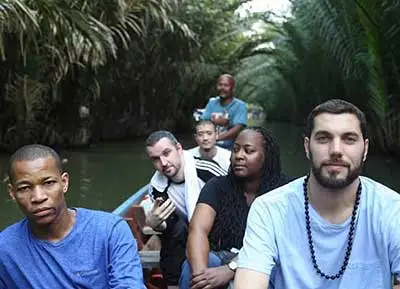
Our portfolio lists Next Level – Thailand, a documentary produced from January to February 2016, credited to the University of North Carolina and the U.S. State Department. Next Level is an initiative of the U.S. Department of State and the University of North Carolina at Chapel Hill: an international hip-hop arts and culture programme in which teams of American hip-hop artist-educators spend two to three weeks teaching and performing in host countries, using music and dance to promote cultural exchange, entrepreneurship and conflict prevention. The 2015 to 2016 host countries were Uganda, Tanzania, El Salvador, Honduras and Thailand.
We have worked on more productions than are listed on this site, and you can see the selection in our portfolio. Our base is in India, where we have worked since 2010, and for each destination we assemble the team with trusted local partners, chosen for your project. For the Indian side of a regional shoot, see our page on working in India, and for the wider picture our where we work page.
How we work
Every production is run personally by our founder, who has more than 25 years of experience in film and television. We start with your brief, then research and scout before we quote, so that the schedule and budget rest on real information. Where you are based is a different question from where the shoot takes place, and we work with producers, broadcasters, agencies and brands around the world. The full process is on our how it works page. If your project includes a sponsor or brand, see sponsorship shoots, and for subtitles and transcription see post-production translation.
Next step
Tell us what you are making, when, and where in Thailand you want to film. We will say plainly what is feasible and what the permit route looks like for your project. Write to anshul@stand4productions.com, call or WhatsApp +91 98718 33930, or use the contact page.